All Events
June 2026 Back to Top

Tuesday, June 2, 2026.


EXCLUSIVE GOLF CLASSIC SPONSORSHIPS -
Please direct any golf related questions to the ISPA office at (224) 333-1622 or via email: dgano@ilsecuritypros.org.
_300x245.png) |  | |
 |  |
July 2026 Back to Top
.png)
Anticipate The Adversary: Using Digital Intelligence to Protect the Human Perimeter
Description: The adversary's first move is rarely physical. Long before anyone appears at your door, attempts a breach, or makes a threatening approach, a sophisticated threat actor has already completed their research — mapping your organization, identifying your people's vulnerabilities, and determining exactly where and how to apply pressure. Most security programs are designed to respond to threats that have already materialized. We’ll address how threats develop before they arrive — and what that knowledge means for how security programs are built, staffed, and led.
Drawing on extensive experience in digital forensics, insider threat investigation, executive protection, and corporate fraud — and informed by a current threat environment that has fundamentally changed how adversaries operate — we’ll give security professionals a clear-eyed view of the intelligence collection process that precedes virtually every significant security incident. Understanding what adversaries are looking for, where they find it, and how they use it against your employees is not a technical discipline. It is a strategic one — and it belongs at the center of how security leaders think about program design, personnel risk, and threat assessment.
We will draw on what the investigative record actually shows — the forensic trail utilized by adversaries who succeeded, and the program decisions that gave them the opening. It is an experienced account of how the threat actually develops, what the investigative record reveals about where programs often fall short, and what separates the organizations that anticipate emerging threats from those that discover them too late.
Learning Objectives -- After attending this presentation, you will be able to:
--Describe the adversary's reconnaissance process — the specific intelligence sources, platforms, and methods used to research organizations and their people — and explain how that process informs a more proactive and intelligence-led approach to physical security program design
--Recognize the digital warning signals that consistently precede physical security incidents, insider threat activity, and targeted fraud — and articulate why those signals are routinely missed by even well-resourced security programs
--Evaluate your organization's current threat assessment framework against the reality of how modern adversaries develop their targeting intelligence — identifying the specific gaps that create exposure before a threat becomes visible in the physical environment
--Assess the risk created by the personal digital exposure of key personnel and their families — and make an informed case to organizational leadership for incorporating executive digital protection into the security program as an institutional risk management priority rather than a personal benefit
--Apply a current threat intelligence lens — including the implications of AI-powered social engineering, voice cloning, deepfake impersonation, and nation-state targeting of US organizations — to your security program's personnel risk framework and leadership communications strategy
August 2026 Back to Top

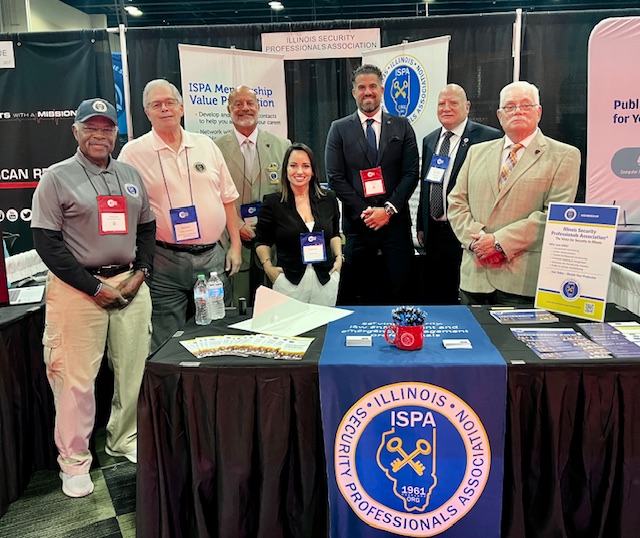
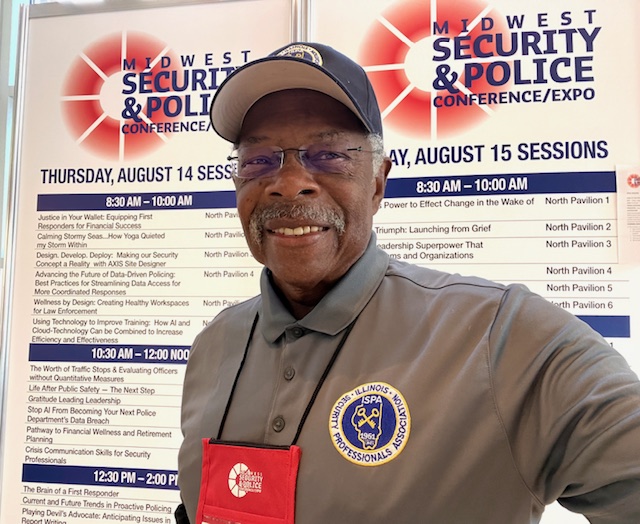
Mark your calendars for the 2026 Midwest Security and Police Conference/Expo! It's set to take place August 13th and 14th, 2026.
Visit ISPA at Booth 222, next to the Illinois Association of Chiefs of Police booth. Find more information on the conference and register at http://mspce.com/. There is no charge to attend this event. Registration should open on or around June 1, 2026.
 |  |  |
 |  |
September 2026 Back to Top
.png)
Charlie Kirk Assassination: After Action Report
On September 10, 2025, Charlie Kirk was assassinated at a rally on the campus of Utah Valley University (UVU). Following that tragedy, UVU hired The Lake Forest Group (TLFG) to conduct a comprehensive, independent review and after-action report of the events at UVU leading up to and immediately following September 10th. The purpose of this project was to:
· Establish a clear and factual account of what occurred.
· Analyze the incident, including contributing factors.
· Evaluate the university’s security and emergency preparation and response actions and protocols.
· Recommend enhancements to current practices informed by the incident.
Learning Objectives
After attending this session, the attendees will know:
· Learn about the timeline of events surrounding the TPUSA program at UVU. This timeline will document all relevant dates and times and provide concise descriptions of the individuals and agencies involved, the actions they took and key decisions they made, and the resulting outcomes. This chronology clearly identifies the critical decision points and contributing factors that influenced event planning, coordination, and operational execution.
· Review and evaluation of the evaluation of the emergency preparedness posture and the response to the September 10, 2025, incident. Our assessment integrates stakeholder interviews, policy and protocol reviews, operational analysis, and benchmarking against national best practices for higher education, large-scale events, and active assailant response.
· Summary of Final Comprehensive After-Action Report:
· Executive Summary: A concise overview focused on lessons learned. Where performance was effective, where improvements are warranted, and how the institution can strengthen a security environment grounded in collaboration, transparency, and coordinated action.
· Detailed Findings and Observations: A comprehensive analysis of prevention, preparedness, response, and recovery efforts before, during, and after the incident.
· Actionable Recommendations: Prioritized, measurable recommendations directly tied to the issues identified in the findings. Each recommendation is specific, practical, and designed to support implementable improvements rather than theoretical guidance.
October 2026 Back to Top
Installation of Suzanne Monreal CPP as
ISPA's 2026 - 2027 President.

NOTE LOCATION:
Maggiano's |111 W. Grand | Chicago, IL
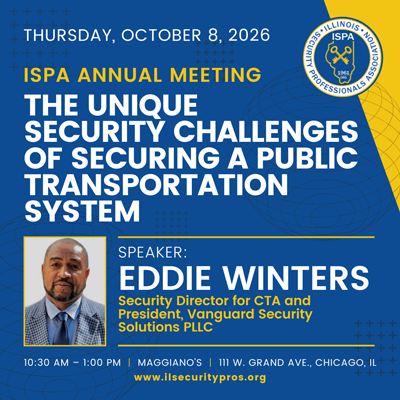
Description:
This presentation explores the unique and evolving security challenges facing public transportation systems in major urban environments. Unlike traditional facilities, transit systems operate as open-access environments with high passenger volume, constant movement, and limited control over who enters the system. These conditions create complex operational and security challenges that require a balanced approach focused on prevention, visibility, behavioral awareness, and rapid response.
Key issues impacting transit safety, including fare evasion, graffiti and vandalism, unhoused populations utilizing transit systems for shelter, and circle riding will be shared with the audience. The presentation also incorporates real-world cases to illustrate how incidents develop, how security vulnerabilities are exploited, and how agencies can strengthen response strategies through intelligence-led operations, technology integration, and coordinated partnerships.
Learning Objectives:
- Identify the unique security risks and vulnerabilities associated with open public transportation systems.
- Analyze how issues such as fare evasion, graffiti, unhoused populations, and circle riding impact transit safety and public perception.
- Evaluate real-world cases to understand incident escalation, behavioral indicators, and operational response challenges.
- Apply layered security strategies, including prevention, detection, intervention, and recovery, within a transit environment.
- Demonstrate an understanding of intelligence-led and behavior-based approaches to improving safety, reducing disorder, and increasing rider confidence.